
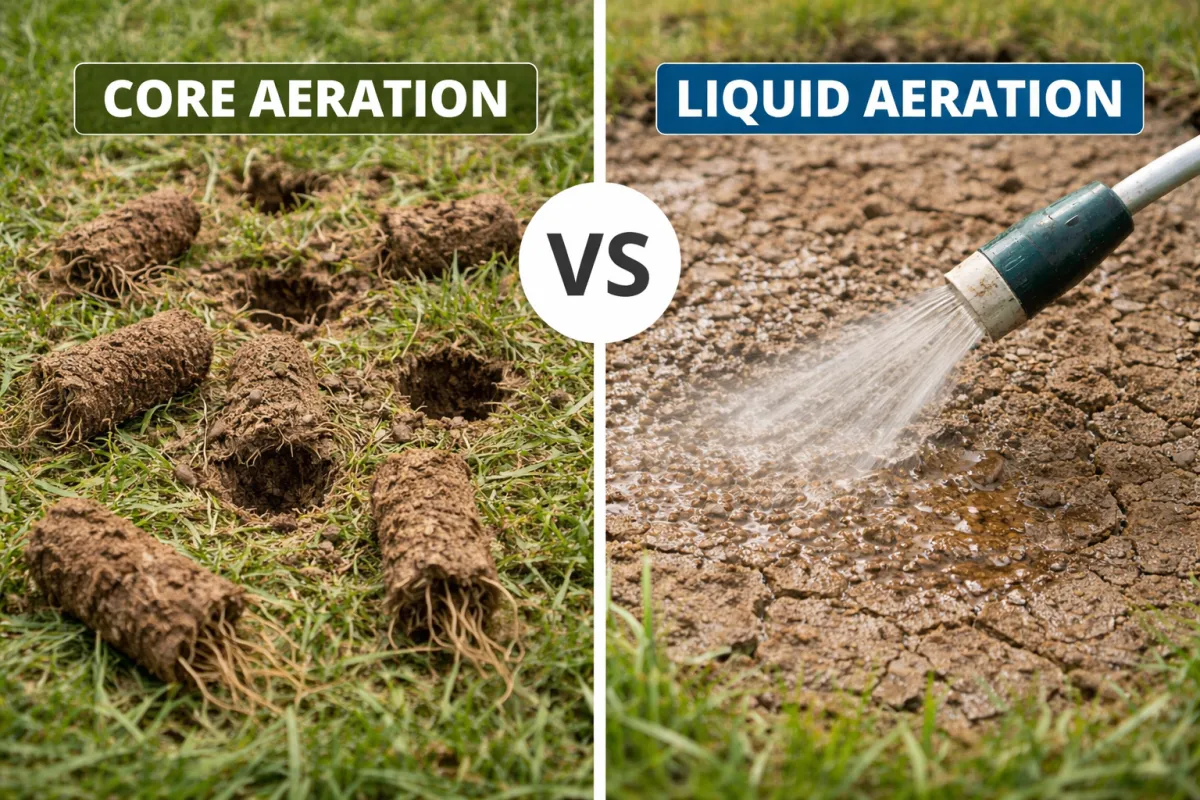
Liquid Aeration vs Core Aeration: Let’s Set the Record Straight in North Texas
There’s been a growing trend in the lawn care industry, especially in North Texas:
Liquid aeration is being marketed as a replacement for core aeration.
It’s not.
Let’s be clear about that upfront.
Liquid aeration may have a place in a lawn care program. It can act as a soil conditioner. It can help improve soil chemistry over time.
But in heavy clay-based North Texas soils, it does not — and cannot — replace core aeration.
What Liquid Aeration Actually Is
Liquid aeration products are typically made up of surfactants, humic acids, and other soil-conditioning agents.
Their purpose is to:
Improve water infiltration
Help break surface tension
Encourage microbial activity
Gradually improve soil structure over time
That’s useful.
But it’s important to understand what they do not do.
They do not:
Physically remove soil
Relieve deep compaction
Create channels for root expansion
Open the soil profile immediately
They work slowly, chemically — not mechanically.
What Core Aeration Does That Liquid Products Cannot
Core aeration physically removes plugs of soil from your lawn.
That matters.
Because in North Texas, our soils are not just compacted — they’re dense, clay-heavy, and often extremely hard.
When these soils dry out, they can become almost brick-like.
I’ve seen lawns where even our Bobcat-built Ryan ZTR aerator, set on its most aggressive setting — “Jack” — has to work to penetrate the ground.
That’s the reality of Texas clay.
And that’s exactly why mechanical aeration is necessary.
Core aeration:
Removes actual soil mass
Relieves compaction immediately
Creates channels for oxygen, water, and nutrients
Allows roots to expand deeper and wider
Improves drainage instantly
Liquid products simply cannot replicate that.
The Clay Soil Reality in North Texas
This isn’t a theoretical discussion.
Clay soil behaves differently than sandy or loamy soil.
When compacted, clay:
Restricts root movement
Blocks water penetration
Limits oxygen exchange
Traps heat near the surface
Becomes harder over time without intervention
You cannot “soften” that structure with a spray and expect the same results as physically removing soil.
That’s like trying to fix a traffic jam by repainting the road.
The problem isn’t the surface.
It’s the density underneath.
Where Liquid Aeration Fits (and Where It Doesn’t)
Liquid aeration can be a supporting tool.
It may:
Help maintain soil conditions between aerations
Improve moisture distribution
Support microbial activity
But it should be viewed as a supplement, not a substitute.
Replacing core aeration entirely with liquid treatments in North Texas clay soils is not a strategy.
It’s a shortcut.
And shortcuts in soil health tend to show up later — in thinner turf, weaker roots, and increased stress during summer.
The American Lawnscape Position
At American Lawnscape, core aeration is a foundational part of our program for a reason.
We deal with real soil conditions, not ideal ones.
We’ve worked on turf long enough — from golf courses to residential lawns — to understand that soil structure drives everything.
If the soil is compacted:
Fertilizer becomes less effective
Water becomes inefficient
Roots remain shallow
Turf becomes vulnerable
Core aeration addresses the problem directly.
Not gradually.
Not theoretically.
Physically.
Don’t Confuse Convenience With Effectiveness
Liquid aeration is easier to apply.
It requires less equipment.
Less labor.
Less disruption.
But easier does not mean better.
In North Texas, where clay soils dominate, effectiveness requires force — not just chemistry.
If your lawn hasn’t been core aerated, or if it’s been several seasons, that’s where the real improvement begins.
Everything else builds on top of that.
Soil First. Always.
There is no fertilizer, no watering schedule, and no weed control program that can overcome severely compacted soil.
Until that structure is addressed, results will always be limited.
At American Lawnscape, we don’t replace fundamentals with convenience.
We build from the ground up.
Because in turf management, just like anything else —
If the foundation is wrong, nothing above it performs the way it should.
Reach out to us for turfcare that is scientifically proven effective. Call/Text 214-308-1322.


