Why By Douglas L. Ringer, PhD — The Turf Veteran
Sometimes the most important thing we can do to improve a struggling lawn has nothing to do with fertilizer, herbicides, or soil amendments; fall leaf removal might be the remedy. We simply need to uncover the grass. That may sound rather elementary, but I’ve seen how easily the condition of the turf itself can be overlooked when the surface is covered with accumulated leaves, grass clippings, and other natural debris. We spend a great deal of time discussing what’s happening beneath the soil, but occasionally the problem is sitting right on top of it.
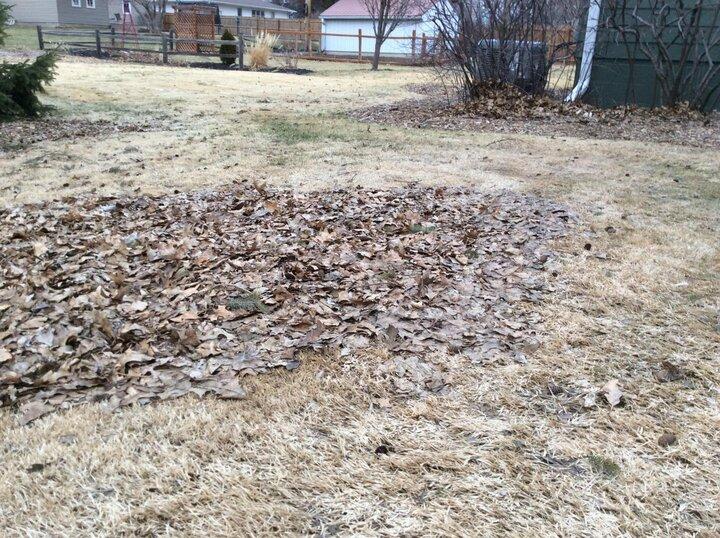
Every fall, homeowners across North Texas watch their trees shed enormous quantities of leaves onto lawns that are already slowing down for winter. Some leaves are collected, some are chopped up by mowers, and plenty are left where they fall. As temperatures decline and mowing becomes less frequent, this material settles deeper into the turf canopy. Winter moisture helps compress it, and what began as a loose collection of leaves and clippings can eventually become a surprisingly dense mat against the growing surface.
The problem becomes especially apparent when spring arrives.
The Problem With What Winter Leaves Behind
Organic matter is an essential component of a healthy lawn. Grass clippings, fallen leaves, and other plant materials contain nutrients that can be returned to the soil through decomposition. Under favorable conditions, soil microorganisms break down this material, releasing nutrients and contributing to the biological processes that sustain healthy turfgrass.
Unfortunately, decomposition doesn’t always proceed as quickly as we’d like. Temperature, moisture, oxygen availability, the type of plant material, and microbial activity all influence how rapidly organic debris breaks down. As soil temperatures decline during winter, biological activity generally slows, although it doesn’t stop completely. Tougher leaves and larger pieces of plant material can remain recognizable for months. Fall leaf removal is critical.
By late winter, the remaining debris may have settled into a compact layer just above the turfgrass growing surface. Damp leaves can adhere to one another, while old clippings and dead plant material become intertwined with the dormant grass. Instead of a loose covering that can easily be collected, we’re left with a flattened mat that often resists the airflow and lifting action of an ordinary mower.
I’ve always found this particularly frustrating because the solution could have been considerably easier several months earlier. Once that material becomes embedded in the canopy, mowing over it doesn’t necessarily remove it. The mower passes across the surface while much of the debris remains pressed against the grass beneath.
Sunlight: The Ingredient We Sometimes Forget
When warm-season turfgrass begins emerging from dormancy, its new green leaves need sunlight to produce energy through photosynthesis. That energy supports continued leaf development, root activity, and the rebuilding of the turf canopy as spring growth accelerates.
Now imagine a layer of decomposing leaves covering those emerging blades. The grass may have adequate soil moisture, available nutrients, and living roots, yet still struggle because its new foliage cannot receive sufficient light. A physical covering can also create localized moisture conditions that differ substantially from the surrounding lawn.
This helps explain why a lawn may green up unevenly in spring. An exposed section begins growing normally while an adjacent area remains weak beneath accumulated debris. The difference isn’t necessarily fertilizer, disease, or soil fertility. Sometimes it’s simply access to sunlight.
We see similar situations in established neighborhoods around McKinney and Melissa, where seasonal leaf accumulation can become an important consideration in maintaining healthy turf. The amount of debris varies considerably with tree cover, landscape design, and mowing practices, which is another reason individual lawn conditions matter more than a universal maintenance schedule. Fall leaf removal acts as sunlight therapy.
Not All Organic Matter Is Bad
Before everyone rushes outside with a rake and a determination to remove every last grass clipping, there’s an important distinction to make. Properly mulched grass clippings are beneficial. Texas A&M AgriLife recommends returning fine, evenly distributed clippings to the lawn because they decompose readily and recycle valuable nutrients.
The difficulty begins when excessive material accumulates faster than it can break down or becomes concentrated in piles and thick layers. A light scattering of finely shredded leaves may be perfectly acceptable. A blanket of wet leaves covering the grass is another matter entirely.
There’s also a difference between surface debris and true thatch. Thatch is primarily an intermingled accumulation of living and dead stems, roots, rhizomes, and stolons between the green vegetation and the soil. It is not simply a collection of fallen leaves or ordinary mowing clippings. Understanding that distinction is important because removing surface debris and correcting excessive thatch are different management practices.
Why Fall Leaf Removal Beats Spring Cleanup
The easiest time to manage fallen leaves is usually while they’re still loose and accessible. Regular removal during autumn prevents large quantities from becoming compressed into the turf through winter rainfall, repeated wetting and drying, and normal settling.
For homeowners, I recommend collecting heavy leaf accumulations as they develop rather than waiting for one enormous cleanup after the trees have finished shedding. Light accumulations can be mulch-mowed when the resulting particles are fine enough to settle between the grass blades without covering the canopy. Heavier accumulations should be collected and removed.
This work also helps prepare the lawn for our fall and winter weed-control applications. Depending on the product and application method, excessive surface debris can interfere with the treatment reaching its intended target. At American Lawnscape, we evaluate what each property needs, but no treatment program can compensate completely for a growing surface buried beneath accumulated vegetation.
If spring arrives and a dense mat remains, gently loosen and remove it when the turf and soil conditions permit. Avoid aggressive raking of soft, saturated ground or disturbing emerging grass unnecessarily. The objective is to expose the growing surface without creating additional injury.
The Turf Veteran’s Take
A healthy lawn depends on a remarkable collection of biological processes working together, but sometimes we make the diagnosis more complicated than necessary. We look for nutrient deficiencies, insect damage, disease, or irrigation problems while overlooking the simple fact that the grass is buried beneath last autumn’s leftovers. Fall cleanup isn’t merely about keeping the yard attractive through winter. It’s about giving the lawn a clean growing surface when spring returns. Sunlight is free, but even free resources aren’t particularly useful when they can’t reach the plant. Before we ask what a struggling lawn needs, it’s worth making certain that nothing is standing in its way.